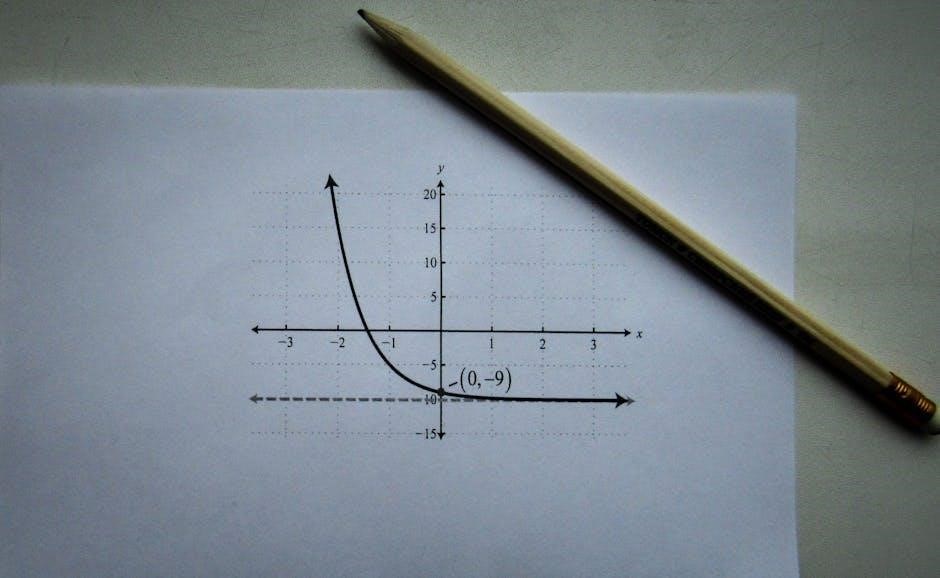
function notation worksheet with answers pdf
Function notation is a concise way to represent mathematical functions, utilizing ‘f(x)’ to denote the output value for a given input ‘x’.
It streamlines expressing equations and analyzing relationships between variables, enhancing clarity in mathematical operations and problem-solving.
What is Function Notation?
Function notation is a powerful and standardized way of representing mathematical functions. Instead of writing ‘y = f(x)’, which can become cumbersome with more complex functions, we use a notation like ‘f(x)’. Here, ‘f’ represents the name of the function, and ‘x’ represents the input value. The result of applying the function to ‘x’ is denoted as ‘f(x)’, which is the output value.
Essentially, function notation provides a shorthand for expressing relationships between inputs and outputs. It allows us to easily evaluate functions for different values of ‘x’ and analyze their behavior. For example, if f(x) = 2x + 3, then f(2) = 2(2) + 3 = 7. This means that when the input is 2, the output is 7. Worksheets focusing on this notation often include exercises where students must identify functions, evaluate them for given inputs, and interpret the results. Understanding this notation is fundamental to advanced mathematical concepts.
Why Use Function Notation?
Employing function notation, like f(x), offers several advantages over traditional equation formats like y = mx + b. Primarily, it enhances clarity, especially when dealing with multiple functions. Each function receives a unique identifier (f, g, h, etc.), preventing confusion. This is crucial when composing functions – applying one function to the result of another – a common practice in calculus.
Furthermore, function notation emphasizes the input-output relationship inherent in functions. It highlights that a function acts on an input to produce an output. Worksheets utilizing this notation often require students to interpret functions in context, understanding what the input and output represent in real-world scenarios. It also prepares students for more advanced mathematical concepts where function notation is indispensable, such as limits, derivatives, and integrals. Ultimately, it’s a more precise and versatile way to represent mathematical relationships.

Understanding Function Notation
Delving deeper, we explore the core components of function notation: the function name, input variable within parentheses, and the resulting output value.
Function Notation: f(x) Explained
The expression “f(x)” doesn’t signify multiplication; instead, it’s a powerful notation representing a function named “f” acting upon an input value “x”. Think of the function as a machine – you feed it an input (x), and it processes it according to a specific rule, delivering an output. This output is the value of the function at that particular input.
The ‘f’ simply labels the function, allowing us to work with multiple functions simultaneously (e.g., g(x), h(x)). The value inside the parentheses, ‘x’, is the argument or input to the function. Replacing ‘x’ with a number allows us to calculate the corresponding output. For instance, if f(x) = 2x + 1, then f(3) = 2(3) + 1 = 7. Therefore, 7 is the output when the input is 3.
Understanding this notation is crucial for interpreting graphs, solving equations, and applying functions in real-world scenarios. It provides a standardized and efficient way to communicate mathematical relationships.
Independent and Dependent Variables
In function notation, variables play distinct roles. The independent variable, typically represented by ‘x’, is the input value – the one we choose or control. It’s “independent” because its value doesn’t rely on anything else within the function. We can freely select any value from its domain.
Conversely, the dependent variable, often denoted as ‘f(x)’ or ‘y’, is the output value. Its value depends entirely on the chosen input ‘x’. Once we select an ‘x’ value, the function dictates the corresponding ‘f(x)’ value. It’s “dependent” because it’s determined by the independent variable.
Consider f(x) = x2 + 2. ‘x’ is independent; we pick a number for ‘x’. ‘f(x)’ is dependent; its value is calculated after we choose ‘x’. Recognizing this relationship is fundamental to understanding how functions model real-world scenarios where one quantity influences another.
Domain and Range in Function Notation
The domain of a function, expressed using function notation, represents all possible input values (‘x’) for which the function is defined. It’s the set of all ‘x’ values that will produce a valid output. Restrictions on the domain often arise from scenarios like division by zero or taking the square root of a negative number.
The range, conversely, encompasses all possible output values (‘f(x)’) that the function can generate. It’s determined by applying every valid input from the domain through the function. The range describes the complete set of potential results.
Determining domain and range is crucial for understanding a function’s behavior. For example, f(x) = 1/x has a domain of all real numbers except 0, as division by zero is undefined. The range is similarly all real numbers except 0. Worksheets often focus on identifying these sets.

Evaluating Functions
Evaluating functions means substituting a specific value for the input variable (‘x’) within the function notation, f(x), to determine the corresponding output value.
Evaluating Functions with Numerical Values
This process involves replacing the variable ‘x’ within the function’s expression with a given number. For instance, if f(x) = 2x + 3, and we want to evaluate f(4), we substitute ‘4’ for ‘x’. This yields f(4) = 2(4) + 3, which simplifies to f(4) = 8 + 3, and finally, f(4) = 11.
Worksheets often present various functions and ask students to calculate the output for several numerical inputs. These problems reinforce the understanding of order of operations and accurate substitution. A typical worksheet might include functions like g(x) = x2 ‒ 5, requiring students to find g(2), g(-1), or g(0).
Accuracy is key; careful substitution and simplification are crucial for obtaining the correct answer. Many worksheets provide answer keys to allow students to check their work and identify areas needing improvement. Mastering this skill is foundational for more complex function evaluations involving expressions or other functions.

Evaluating Functions with Expressions
Evaluating functions with expressions instead of numerical values builds upon the basic substitution skill. Here, ‘x’ is replaced with an algebraic expression, like ‘a + 1’ or ‘2b ౼ 3’. For example, if f(x) = x2 + 1, and we need to find f(a + 1), we substitute (a + 1) for ‘x’, resulting in f(a + 1) = (a + 1)2 + 1.
This requires expanding the expression – in this case, (a + 1)2 becomes a2 + 2a + 1 – and then simplifying the entire function. Worksheets focusing on this skill often include functions with multiple variables or more complex expressions.
Students must demonstrate proficiency in algebraic manipulation alongside function notation. Answer keys are vital for verifying the correct expansion and simplification steps. These exercises prepare students for advanced mathematical concepts where function composition and more intricate substitutions are common.
Using Function Notation with Different Inputs
Worksheets frequently challenge students to evaluate the same function with a variety of inputs – numbers, variables, and even other functions. This reinforces the understanding that ‘x’ is simply a placeholder. For instance, given f(x) = 3x ‒ 2, a worksheet might ask for f(0), f(5), f(a), and f(x + h).
The key is consistent substitution. f(x + h) requires replacing every ‘x’ with ‘(x + h)’, leading to f(x + h) = 3(x + h) ‒ 2. Simplifying then yields 3x + 3h ౼ 2.

These exercises highlight the function’s behavior across its domain. Answer keys provide crucial feedback, showing correct substitution and simplification. Mastering this skill is fundamental for understanding function transformations and more complex mathematical modeling. Worksheets often include increasingly complex inputs to test comprehension.

Function Notation Worksheets & Practice
Numerous free, printable function notation worksheets (often in PDF format) are available online, complete with answer keys, to reinforce learning and assess comprehension.
Types of Problems on Function Notation Worksheets
Function notation worksheets commonly present a variety of problem types designed to build proficiency. A core component involves evaluating functions – given f(x) = 2x + 3, students find f(2), f(-1), or f(a+1). These exercises solidify understanding of substituting values into the function rule.
Worksheets also frequently ask students to express equations in function notation. For example, converting y = 5x ‒ 2 into f(x) = 5x ‒ 2. This tests their ability to recognize the input-output relationship.
Another common type involves identifying the function rule given a set of input-output pairs. Students must deduce the equation that maps the inputs to the outputs. More advanced worksheets include problems requiring students to perform operations with functions, such as finding f(g(x)) or f(x) + g(x).
Finally, many worksheets incorporate real-world application problems, where function notation is used to model scenarios like calculating costs or distances. Answer keys are crucial for self-assessment and identifying areas needing improvement.
Linear Functions and Function Notation

Linear functions are exceptionally well-suited for representation using function notation. A linear function, generally expressed as y = mx + b, translates directly to f(x) = mx + b, where ‘m’ represents the slope and ‘b’ the y-intercept. Worksheets focusing on linear functions and notation emphasize evaluating f(x) for various ‘x’ values, reinforcing the concept of slope as the rate of change.
Problems often involve finding the function rule given two points on the line, requiring students to first calculate the slope and then determine the y-intercept. Worksheets also present scenarios where students must interpret the meaning of f(a) in a linear context – for instance, what does f(5) represent in a function modeling cost versus quantity?
Furthermore, students practice graphing linear functions defined in function notation, connecting the algebraic representation to its visual counterpart. Answer keys provide verification of both calculated function values and graphical representations, ensuring a solid grasp of linear functions within the framework of function notation.
Quadratic Functions and Function Notation
Quadratic functions, defined by the general form f(x) = ax² + bx + c, also benefit significantly from function notation. Worksheets dedicated to quadratic functions explore evaluating f(x) for given ‘x’ values, often requiring careful attention to the order of operations due to the exponentiation. A key focus is understanding how changes in ‘a’, ‘b’, and ‘c’ affect the parabola’s shape and position.
Problems frequently involve finding the vertex, axis of symmetry, and x-intercepts using function notation, building upon prior knowledge of quadratic equation solving. Students practice interpreting f(x) in real-world scenarios, such as projectile motion or area calculations.
Worksheets also present tasks like comparing quadratic functions expressed in function notation, determining which has a larger maximum or minimum value. Comprehensive answer keys are crucial for verifying solutions, including correctly identifying the vertex coordinates and accurately graphing the parabola based on the function rule.

Solving Problems with Function Notation
Applying function notation involves translating real-world scenarios into mathematical expressions, evaluating functions, and interpreting results within the problem’s context.
Real-World Applications of Function Notation
Function notation isn’t confined to abstract mathematics; it’s a powerful tool for modeling and analyzing real-world phenomena. Consider a cinema scenario – determining film eligibility based on age and rating. Here, a function, E(age, rating, ID), could represent eligibility, outputting ‘true’ or ‘false’.
Similarly, in business, a profit function, P(x), can model profit based on the number of units sold (x). Engineering utilizes function notation to describe relationships between variables, like the distance a projectile travels, d(v, θ), based on initial velocity (v) and launch angle (θ).
Even everyday situations benefit. Calculating delivery costs, C(weight, distance), or determining the total cost of a phone plan, T(data, minutes), are easily expressed using function notation. Worksheets focusing on these applications help students bridge the gap between theoretical understanding and practical problem-solving, reinforcing the utility of this mathematical concept.
Interpreting Function Notation in Context
Understanding function notation goes beyond simply substituting values; it requires interpreting the meaning within a given context. For example, if h(t) represents the height of a projectile at time t, then h(5) doesn’t just equal a number – it signifies the height of the projectile specifically at 5 seconds.
Similarly, if C(x) models the cost of producing x items, C(100) represents the cost of producing 100 items, not just any arbitrary value. Worksheets often present scenarios requiring students to translate these notations into plain language.
Successfully interpreting function notation demands recognizing the variables’ units and the function’s overall purpose. A worksheet with answers provides crucial feedback, allowing learners to refine their comprehension and confidently apply this skill to diverse real-world problems, solidifying their grasp of the underlying concepts.

Resources for Function Notation Practice
Numerous free, printable function notation worksheets (PDF format) are available online, alongside interactive calculators and detailed answer keys for self-assessment.
Free Printable Function Notation Worksheets (PDF)
Accessing free, printable function notation worksheets in PDF format is an excellent way to reinforce learning and build proficiency. These resources typically offer a diverse range of problems, starting with basic function evaluation using numerical inputs and progressing to more complex scenarios involving expressions and different input types.
Many worksheets focus on translating between equation form and function notation, solidifying understanding of equivalent representations. You’ll find exercises designed to assess comprehension of independent and dependent variables, as well as practice identifying the domain and range of functions expressed in notation.
Crucially, look for worksheets that include answer keys. These allow for immediate self-checking, promoting independent learning and identifying areas needing further review. Websites offering these resources often categorize worksheets by skill level, making it easy to find appropriate practice material. Utilizing these PDFs provides a cost-effective and convenient method for mastering function notation.
Online Function Notation Calculators
Several online function notation calculators can significantly aid in understanding and verifying solutions related to function notation problems. These tools allow users to input a function, typically in the form of f(x) = …, and then evaluate it for specific input values. This is particularly helpful when dealing with complex functions or when checking answers obtained from worksheets.
Many calculators also offer step-by-step solutions, demonstrating the process of function evaluation, which is invaluable for learning. Some advanced calculators can even handle composite functions and inverse functions, expanding their utility beyond basic evaluation.
While these calculators shouldn’t replace practice with worksheets – especially those with answer keys for self-assessment – they serve as excellent supplementary resources. They provide immediate feedback and can help identify common errors. Remember to use them as a learning tool, focusing on understanding the underlying concepts rather than simply obtaining answers.
Answer Keys for Function Notation Worksheets
When utilizing function notation worksheets, especially those available as PDFs, access to a corresponding answer key is crucial for effective self-study and assessment. Answer keys allow students to immediately verify their solutions, identifying areas where they excel and pinpointing concepts requiring further review. This immediate feedback loop is significantly more beneficial than waiting for a teacher’s assessment.
A good answer key doesn’t just provide the final answer; it often includes step-by-step solutions, demonstrating the correct process for evaluating functions, determining domains and ranges, or interpreting function notation in context. This detailed approach fosters a deeper understanding of the underlying principles.
When searching for “function notation worksheet with answers pdf,” prioritize resources that offer comprehensive answer keys. These resources empower independent learning and build confidence in tackling more complex mathematical problems.